Televangelist Benny Hinn Served Lawsuit While Preaching

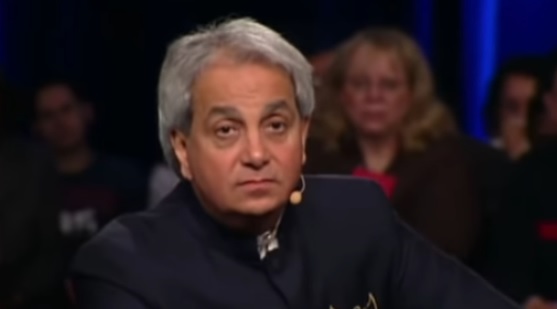
Norman Quintero, CEO of TeleAmerica Television Network and Senior Pastor of Iglesia Getsemani in Anaheim, California, has sued Benny Hinn, Hinn-associate Donald B. Price and publicist Ronn Torossian for defamation. Hinn was served the lawsuit while speaking during a “Miracle Service.”  The exchange can be viewed on YouTube.

In a lawsuit filed in Superior Court Orange County, California, Quintero alleges that Price published a website “to destroy Dr. Quintero’s personal reputation.” According to the lawsuit, “The Website states, or at least implies, that Dr. Quintero has been convicted on criminal charges. The statement is false.”

While the offending website norman-quintero.com is now offline, a backup copy of the website can be viewed at the Internet Archive.

Price, a loyal officer at Benny Hinn Ministries, also runs eMinistries Consulting and Family Altar of the Air.

Meanwhile, the lawsuit lacks many details on Hinn’s alleged role in the defamation.  Hinn’s alleged role will probably surface during court testimony.

The court battles began in 2021, with Price suing Quintero in Dallas County Court “for tortious interference with contract, tortious interference with prospective contract, defamation, and business disparagement, stemming from a failed real estate transaction,” as one court filing summarizes the case.

The case took a quick detour in the United States District Court for the Northern District of Texas before being remanded to the lower court because of a question about Quintero’s residency.

However, the court may have questioned the wrong person’s residency. Price’s lawsuit says, “Plaintiff, Donald B. Price, is an individual residing in Dallas County, Texas.”

Trinity Foundation investigators, which are based in Dallas, searched Dallas County Appraisal District and found zero evidence of Price residing in Dallas County. Why would Price live in Dallas, when his “ministry” Family Altar of the Air owns a 14,500 square-foot mansion worth $6 million a short distance away in Collin County?

Family Altar of the Air also owns a Florida mansion worth over $4 million.

Just how many homes does Price and his organizations own? Is this good stewardship?

Perhaps these “ministry” leaders should sell an extra home to fund their ministry rather than rely on the generosity of donors.

Missing Money: $544,817 Disappeared from Juanita Bynum Ministries


Missing money is a big red flag for investigators. So, let’s examine the Form 990s filed by televangelist Juanita Bynum’s new non-profit organization which was incorporated in 2016.

But first, a math quiz: Zero minus zero equals …

For 2016, The Juanita Bynum II Ministry Inc (That’s the official ministry name) reported zero total assets and zero liabilities. Subtracting zero from zero yielded an amazing answer: $163,854 in net assets.

What happened to net assets in 2017? They disappeared.

For 2017, the ministry reported total revenue of $383,272 and total expenses of $242,450 resulting in a surplus of $140,822 which disappeared with the net assets reported from the previous year.

For 2018, the ministry reported total revenue of $639,280 and total expenses of $399,139 resulting in a surplus of $240,141 which also disappeared.

At the end of 2018, the non-profit organization reported zero net assets.

The IRS should conduct an audit to determine where the $544,817 in unreported surpluses went.

Zero Accountability

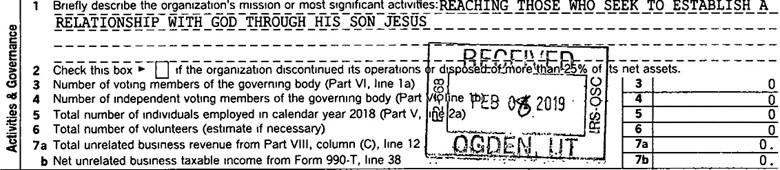
Another troubling issue was noticed while reviewing the 990s. On page one of each 990, the ministry reports zero board members. There is zero accountability for the organization.


Time to Review Church Budgets


With the arrival of the year 2023 in two months, that means many church elders and board members will soon be voting to approve church budgets.

Bob Santy, Executive Pastor of Operations at Sunridge Community Church in Temecula, California, recommends that churches finalize a budget two months before the church fiscal year.

Budgets reveal church priorities. Here are several critical questions that can guide a church leader on voting to approve a church budget. The same questions can also help concerned donors evaluate their financial support for a church:

Discipleship: When Jesus gave the Great Commission to His followers, Jesus told them to make disciples. This is the purpose of the church. Is the church effectively making disciples? If the church is declining, does the church need new leadership or to change its financial priorities by investing more in discipleship programs?

Program Services: How much does the church spend on its stated mission? By subtracting administrative and fundraising expenses, a concerned donor can determine how much is spent on program services.

Salaries: According to executive search firm Vanderbloemen, “The average church uses 52% of the church budget on compensation.” Often the highest paid church employee is the senior pastor. Is the pastor paid too much? Does the pastor receive an outrageous housing allowance? If the senior pastor were paid less, would the church be able to hire another employee? Are the church salaries reasonable?

The IRS website asks an important question: “How do we know whether the compensation we’re paying to our officers and key employees is reasonable?” The answer: “Reasonable compensation is the value that would ordinarily be paid for like services by like enterprises under like circumstances.”

Transparency: Is the church refusing to disclose big ticket expenses? If a  church refuses to disclose pastor salaries, there might be excessive compensation.  If the church has been sued, is the church disclosing attorneys’ fees?

Donor responsibility: In response to the infamous Jim Bakker/PTL scandal, Congress held a hearing in 1987. Pastor D. James Kennedy testified, “I would think that if a person is going to give money to something, that they have … a responsibility to learn where it is going.”

Donor responsibility should serve as a check to prevent the church from straying from its mission to evangelize the world, make disciples, help the poor, the fatherless, the stranger and the widows. If the church primarily operates as a social club for its members, then donors should take their money elsewhere.

Nepotism: Ministry Family Members Compensated Over $3 Million

Most evangelical Christians have never heard of “prophet” Chuck Pierce and his “family business” Glory of Zion International. Pierce is a widely respected individual among charismatic and Pentecostal Christians who believe that God is raising up a new generation of prophets to guide the church.

This respect is not warranted. Two huge red flags, nepotism and excessive compensation, in Pierce’s ministry should raise important questions for donors.

According to the ministry’s latest Form 990 which recently became public, seven Pierce family members received $3,779,930 in compensation and independent contractor payments from April 1, 2020 to March 31, 2021.


(Photo: Spreadsheet of Pierce Family compensation)

In the past four years, Chuck Pierce has been compensated more than $5 million.

By operating as a ministry, Glory of Zion International exploits a loophole in the tax code. Non-profit executives who serve as ministers or paid as independent contractors are not subject to an excise tax on compensation of more than $1 million.


(Photo: Page 5, Line 15 of 2020-21 Form 990)

Who determined how much each of the Pierces are paid? This information is not disclosed to the IRS. It is possible that Chuck Pierce determines his own salary.

(Photo: Schedule J of 2020-21 Form 990)

Normally, when a non-profit organization pays an executive more than $1 million, the organization would rely upon a compensation study to justify a large salary which would then be approved by the board. Three of eight voting board members are from the Pierce family.

Out of the six highest paid employees, four are family.  Nepotism is a widespread problem in megachurches and religious media ministries. Church members and ministry donors should hold religious leaders to higher ethical standards. Nepotism and excessive compensation  in ministries should serve as red flags for donors to avoid.


Checkbooks, Bank Cards and Bank Statements Reveal Pastor Priorities: Pastor James MacDonald and the Ethics of Gift Giving

(Photo: PO Box and bank routing number redacted. Reimbursement check written by James MacDonald’s executive assistant Sharon Kostal.)

Note: This is the first article in a series examining financial records and receipts for pastors and religious organizations. Future articles will explore travel expenses and per diem expenses.

“It has been said, ‘Show me a person’s checkbook and I can tell you what he cares about.'” – Social Action, 1964

James MacDonald, the controversial former pastor of Harvest Bible Chapel (HBC), is attempting to restore his reputation.   In July, MacDonald posted on his website copies of checks as proof that he reimbursed (HBC) for personal expenses incurred during his time as pastor. One reimbursement check, dated December 28, 2018, was for $27,172.39!

The checks challenged a claim that MacDonald failed to reimburse the church.

MacDonald also provided monthly lists of church financial transactions revealing the cost of airline tickets, charter aircraft service and gifts to pastors.

Concerned church donors and religion reporters rarely have access to this kind of financial information.

Monthly statements disclosed that HBC and MacDonald’s media ministry Walk in the Word shared the cost of purchasing more than $1,000 of cufflinks for church employees. Other transactions included the purchase of more than $1,500 in gifts from Bloomingdales for a Greg Laurie marriage conference and $10,683.09 spent on taxidermy in the first half of 2016.

Continue reading “Checkbooks, Bank Cards and Bank Statements Reveal Pastor Priorities: Pastor James MacDonald and the Ethics of Gift Giving”

Privacy Laws Prevent Financial Transparency, Hurt Efforts to Investigate Religious Fraud

In the name of privacy, laws often protect devious administrators working inside religious non-profit organizations and churches. Journalists and concerned donors are denied access to critical government information.

Let’s look at three examples.

  • Money Trail Not Available

During the Great Depression, religious book publisher Zondervan launched a small Christian bookstore. The little retail business went through several name changes and grew into America’s largest religious bookstore chain, Family Christian Stores.

Marketplace changes, brought about by digital song downloads from Apple and book sales through Amazon, resulted in Family Christian’s sales declining.

In 2013, as Family Christian Stores reorganized to form a non-profit organization, Family Christian TR, LLC was registered in the island nation of Saint Kitts and Nevis, famous for its offshore banking. Two years later, Family Christian filed for bankruptcy and the financial trust ceased operation.

Family Christian’s bankruptcy hurt numerous publishers of books, CDs and DVDs as the organization failed to pay distributors for product.

Is it possible that some revenues, which would have compensated distributers, were embezzled and then transferred to the aforementioned account as a tax haven?

Meanwhile, unconfirmed allegations of money laundering by deceased televangelists also persist.

There may exist a paper trail providing evidence of financial crimes. Banks are required to report customers making deposits of $10,000 or more in cash. However, these Suspicious Activity Reports (SAR) are protected by the Bank Secrecy Act and cannot be obtained by Freedom of Information Act requests.

Congress could amend the Bank Secrecy Act to allow journalists to submit FOIA requests to the Treasury Department for SAR of deceased individuals and companies no longer in operation.

Continue reading “Privacy Laws Prevent Financial Transparency, Hurt Efforts to Investigate Religious Fraud”

After Preaching for Christians to Expect Divine Healing, Kenneth Copeland Admits Pacemaker


(Photo: Kenneth Copeland preaching on August 1, 2022)

During this year’s Southwest Believers Convention in Fort Worth, televangelist Kenneth Copeland announced that his wife Gloria would not be in attendance because of her health. Kenneth explained that early in their marriage, over 50 years ago, Gloria received a traumatic brain injury during a car accident.

Kenneth also revealed he uses a pacemaker because of an irregular  heartbeat.

These confessions are at odds with the Copelands’ theology.

For decades, Kenneth and Gloria Copeland have preached that it is God’s will to heal all Christians, but sin and unbelief prevent many healings.

These statements are easy to find in sermon videos on YouTube and in ministry articles. The documentary Suffer the Children critically examines the health and wealth gospel of the Copelands.

Continue reading “After Preaching for Christians to Expect Divine Healing, Kenneth Copeland Admits Pacemaker”

Who Can Fire the Pastor?

(Photo: Church governance models determine whether church “members”  or board members can remove a pastor or priest.)

“Who can fire the pastor?”  It’s a key question to ask when investigating the power structure of churches and ministries as a growing number of pastors adopt barriers to accountability which prevent them from being fired.

Sometimes corrupt pastors are protected by family members and yes men serving on church boards or corporation documents providing dictatorial powers.

Church articles of incorporation and church bylaws determine if church attendees can be members and if they are allowed to vote on church business.

In 2011, televangelist Eddie Long settled lawsuits with five men accusing him of sexual assault. Long did not disclose how much New Birth Missionary Baptist Church (NBMBC) spent to resolve the litigation. Concerned church attendees lacked the ability to remove the pastor from the pulpit.

Continue reading “Who Can Fire the Pastor?”

Documentary Reveals the Mind of a Pastor Conman

(Article updated with information about televangelists obtaining loans from mafia-connected individuals.)

The three-episode Discovery+ documentary series King of the Con tells the life story Barry Minkow, an infamous conman turned pastor, who subsequently robbed a church of $3 million dollars. The Bible warns of people like Minkow, “As a dog returns to its vomit, so fools repeat their folly.” – Proverbs 26:11 NIV

Minkow’s life could serve as a playbook for corrupt televangelists as so many of the same techniques are repeatedly used.

Through interviews Minkow describes how he rationalized his criminal behavior. “Looking back, it sounds crazy but at the time I really didn’t think it was so bad.”

As a teenager, Minkow started ZZZZ Best, a carpet cleaning company, in Inglewood, a small city near Los Angeles. When he was 19 years old, ZZZZ Best went public. As investors purchased stocks, the company’s value soared and a year later was worth $280 million. (Wikipedia provides a good overview of Minkow’s crimes.)

Minkow hired publicist Jeri Carr to promote his company. Local media enjoyed telling the story of a high school student launching a successful business. Carr and the media didn’t know that Minkow was also operating an illegal insurance restoration scheme. Insurance companies were billed for work that was never performed.

Early in the history in ZZZZ Best, Minkow needed funding to grow and turned to mafia-connected Jack Catain for a loan. The mafia generated large profits by loan sharking which is providing high-interest loans to people and businesses that banks considered too risky to serve. This may surprise many Christians but at least two televangelists have received loans from mafia-connected figures.

In his autobiography The Soul-Winning Century, Rex Humbard revealed how he received a loan from Jimmy Hoffa, the infamous president of the Teamsters. The union’s pension fund also financed criminal enterprises as Hoffa made lucrative loans to mafia, according to Harvard law professor Jack Goldsmith

Robert Tilton’s church obtained a loan from Herman Beebe, an associate of Carlos Marcello, former head of the New Orleans mafia. In 1993, Tilton testified about the loan in federal court, “After we had gotten the loan from his insurance company we began to hear rumors and people saying that when you borrowed money from these particular people, that if you missed a payment they were prone to come and take over your properties, and that they were the type of people that we did not want to have any type of association with, and so we paid the loan off as quickly as possible.”

After ZZZZ Best’s Ponzi scheme collapsed following critical news coverage and a federal investigation, a jury convicted Minkow of fraud.

Continue reading “Documentary Reveals the Mind of a Pastor Conman”

Televangelist Creflo Dollar Preaches Against Tithing (We’re doing a double take on this one)

In two recent Sunday sermons Televangelist Creflo Dollar preached against tithing based on fear and guilt. On July 3rd, Dollar told his congregation, “I would argue that tithing isn’t required or even encouraged for believers in Jesus Christ…”

Instead, Dollar is now preaching that Christian giving should be based on gratitude.

Dollar made a surprising announcement in his June 26th, sermon titled “The Great Misunderstanding” about how his beliefs on tithing changed.

“I want to start off by saying to you that I’m still growing and that the teachings I’ve shared in times past on the subject of tithing were not correct. And today I stand in humility to correct some things I have taught for years and believed for years, but could never understand it clearly because I had not been confronted with the Gospel of grace, which has made the difference.

I won’t apologize ’cause if it wasn’t for me going down that route, I would have never ended up where I am right now. But I will say that I have no shame at all saying to you throw away every book, every tape and every video I did on the subject of tithing, unless it lines up with this.”

While Dollar’s rejection of fear-based giving is welcome, a lot of questions remain, and Trinity Foundation investigators wonder if Dollar is simply changing his message to appeal to a larger audience.

Yes, consider us skeptical. If a preacher is unwilling to apologize for leading people astray, does he really “stand in humility” as Dollar claimed?

Continue reading “Televangelist Creflo Dollar Preaches Against Tithing (We’re doing a double take on this one)”